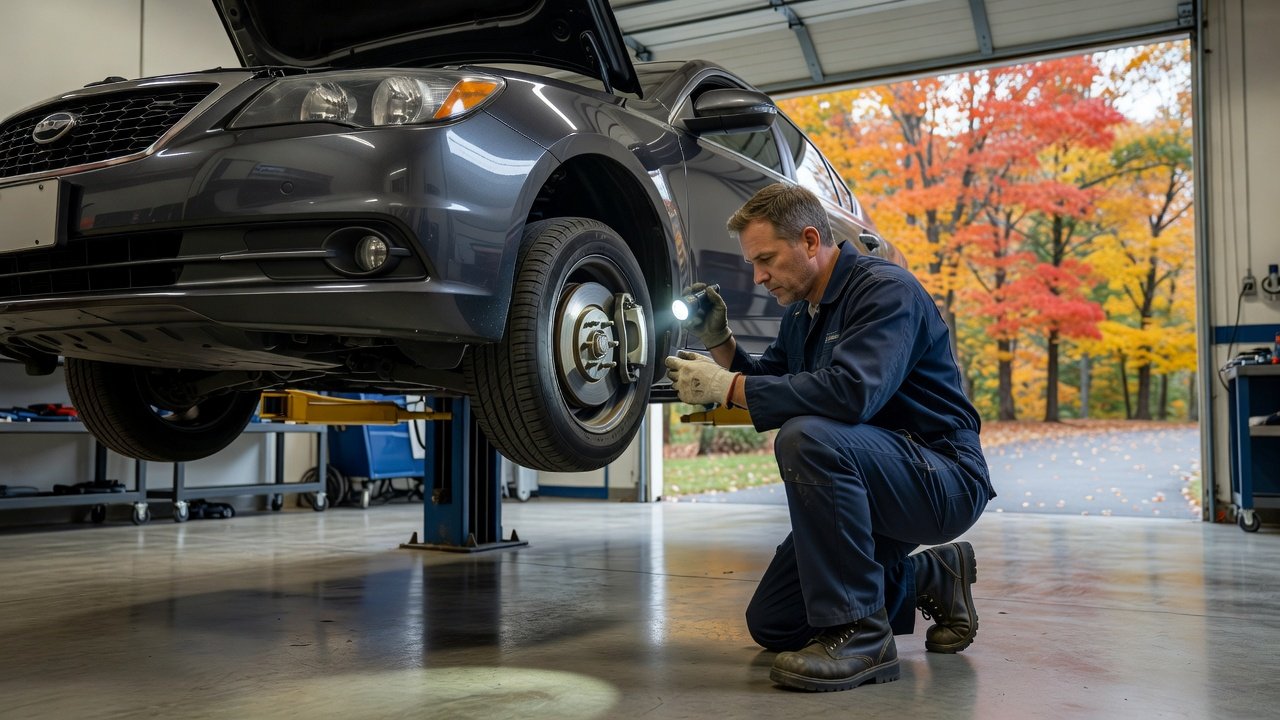
Drive across any Connecticut border and the inspection rules change. Cars registered in New York and Massachusetts carry a windshield sticker showing they passed a safety inspection in the past year. Rhode Island checks safety and emissions together every two years. Connecticut has no periodic safety inspection for most passenger cars. It tests emissions every two years and saves a full mechanical inspection for a short list of special cases. For anyone who commutes across state lines, moves within the region, or buys a used car from a neighboring state, those differences decide what has to happen before a vehicle is legal to drive.
DMVCT Compliance Review is not the Connecticut Department of Motor Vehicles or any other state agency. Check each state’s official pages for current forms, fees and rules before acting on anything here.
Connecticut: emissions every two years, safety checks by exception
The biennial emissions test
Connecticut law requires most motor vehicles to pass an emissions inspection every two years, according to a Connecticut Office of Legislative Research report citing CGS § 14-164c. The state DMV’s emissions testing page lists the test fee as $20.00, paid to the private test center, not to the DMV.
Two age groups are exempt, per the DMV: vehicles younger than four model years, and vehicles from model year 2001 and older. Third-party sites still quote other cutoffs, such as 25 years or model year 1996, so rely on the DMV’s own list.
Missing the deadline is expensive in a small way. The DMV’s late fee page sets the emissions late fee at $20 and says it applies when a vehicle is tested more than 30 days past its due date, when a failed vehicle is not retested within 60 days, or when a time extension runs out before the test. An aborted test does not count as a completed one. The DMV bills the late fee separately and warns that leaving it unpaid can affect your ability to renew or register the vehicle.
Where safety inspections still apply
Connecticut has no annual safety sticker, but some vehicles get a safety check. According to the DMV’s VIN verification page, some vehicles need a VIN verification before they can be registered. Most of these are done at official inspection stations for $10. A defined group must go to the DMV Inspection Lane at 60 State Street in Wethersfield instead, including:
- Salvage vehicles
- Composite and homemade vehicles or trailers
- Grey-market vehicles imported from other countries
- Amphibious and former military vehicles
- Motorcycles from model year 1980 or older
The DMV does not charge for VIN verifications done at the Inspection Lane, but it tells owners to “be prepared for a full vehicle safety inspection.” The vehicle has to be operational and road-legal, and anything brought in on a trailer must be unloaded so inspectors can test the brakes, lights and horn.
Registration runs on a two-year cycle
Most Connecticut passenger registrations run for two years. The same legislative report notes a $10 federal Clean Air Act fee collected with each two-year registration, on top of the emissions test fee. Since emissions tests are also biennial, many owners deal with both on roughly the same rhythm, but the due dates are separate. Check your test due date on the state’s emissions program site rather than assuming it matches your registration.
New York: annual safety plus emissions
New York runs the strictest schedule of the four states. According to the NY DMV, vehicles must be inspected every 12 months and when ownership changes. Most inspections include a safety check and an OBD II check of emissions controls. Diesel vehicles get a diesel emissions inspection along with the safety inspection.
What it costs
The DMV’s VS-77 Inspection Groups and Fee Chart sets maximum fees that stations may charge. For a light passenger vehicle:
- Safety inspection: up to $10
- OBD II emissions inspection: up to $27 at stations inside the New York Metropolitan Area, up to $11 outside it
So the most a station can charge a typical car owner is $37 downstate and $21 elsewhere. Stations may charge less, there is no sales tax on inspection fees, and the fee is owed whether the car passes or fails.
Exemptions and penalties
Vehicles less than two model years old, more than 25 model years old, electric vehicles and cars on historical plates are among those exempt from the emissions portion, though most still need the safety inspection. Fines for an expired sticker run $25 to $50 if it lapsed within the past 60 days and $50 to $100 beyond that or with no sticker, plus a mandatory surcharge of $88 ($93 in town and village courts).
New residents get some grace. The NY DMV says an out-of-state inspection stays valid until it expires or one year after the New York registration date, whichever comes first. If your previous state issued no inspection sticker, as with a Connecticut car, you have to get a New York inspection.
Massachusetts: annual safety and emissions sticker
Massachusetts also inspects every year. The state’s inspection program, Massachusetts Vehicle Check, says all vehicles driven on Massachusetts roads must pass an annual safety inspection. The fee is $35 for most vehicles, and commercial inspections cost more.
The safety portion checks 14 components, including brakes, lighting, tires, seat belts and airbags. Newer light-duty vehicles also get an onboard diagnostics emissions test at the same visit. Common emissions failures listed by the program include faulty oxygen sensors, EGR valves, catalytic converters and evaporative controls.
The timing matters for buyers. Mass.gov guidance says a newly purchased vehicle must be inspected within 7 days of its registration date. A driver who registers a used car in Massachusetts on a Monday has about a week, not a year, to get the sticker.
Rhode Island: biennial safety and emissions combined
Rhode Island falls between Connecticut and its other neighbors. The state inspection regulation (280-RICR-30-15-3) requires light-duty vehicles to be inspected for emissions and safety items biennially. The maximum fee for a two-year emissions and safety inspection on a vehicle under 8,500 pounds, including diesels, is $55.
New vehicles are exempt until 24 months after their first purchase date or 24,000 miles, whichever comes first. Used vehicles registered without a valid Rhode Island inspection approval must be inspected and approved within five Division of Motor Vehicles business days of registration. That is one of the tightest windows in the region.
Side by side
| State | Safety inspection | Emissions test | Interval | Typical fee |
|---|---|---|---|---|
| Connecticut | Only for special cases (DMV Inspection Lane) | Yes, most vehicles | Every two years | $20 emissions; $10 VIN verification where required |
| New York | Yes | Yes (OBD II) | Every 12 months and at ownership transfer | Up to $37 in the NYMA, $21 elsewhere |
| Massachusetts | Yes | Yes (OBD) | Every year | $35 for most vehicles |
| Rhode Island | Yes | Yes | Every two years | Up to $55 |
What this means if you cross state lines
Moving from New York, Massachusetts or Rhode Island to Connecticut removes a step: you will not need a safety sticker for an ordinary car. You will still need an emissions test or VIN verification before registering, and the vehicle joins the two-year emissions cycle. Our new-resident registration guide covers that sequence.
Moving the other way adds work. A Connecticut car has never had a safety inspection, so New York requires one after you register there, and Massachusetts expects the newly registered vehicle inspected within days. Worn brakes, tires or lights that never came up in Connecticut will come up at the first out-of-state inspection.
For used-car buyers, a Connecticut emissions pass says nothing about brakes or tires. If a car has only ever been registered in Connecticut, budget for a pre-purchase mechanical inspection, especially if you plan to register it in a neighboring state. Look up the test due date, confirm the current fee on the state’s own site, and book the inspection before the registration paperwork, not after.