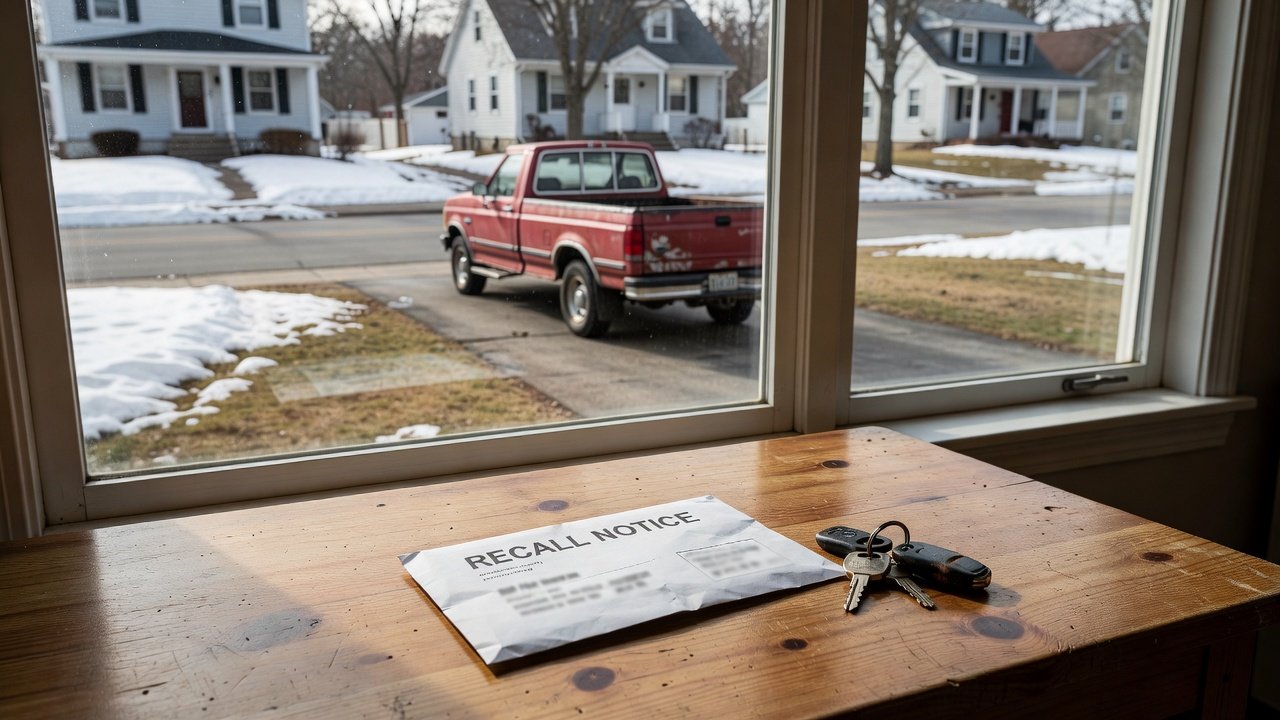
Most safety recall letters tell owners to schedule a repair at their convenience. A small subset tell owners to stop driving the vehicle immediately. That second category — the “do not drive” warning — carries a materially different risk calculation, and 2026 has produced an unusually visible run of them.
One clarification is worth making at the outset, because the phrase “NHTSA’s wave of do-not-drive recalls” compresses two different things. A recall is issued by the manufacturer, and NHTSA either prompts it through an investigation or accepts it when the manufacturer files. The “do not drive” language is an escalated advisory layered on top of an existing recall — usually issued jointly by the manufacturer and NHTSA when the defect’s failure mode is severe enough that continued driving is not an acceptable risk while the owner waits for parts. Almost none of the vehicles under a do-not-drive warning in 2026 are newly recalled. They are vehicles recalled years ago whose owners never got the repair done.
What is currently under a do-not-drive warning
The largest population by a wide margin is the Takata airbag inflator recall, the biggest automotive recall in U.S. history. In February 2026, FCA US issued a do-not-drive warning covering all remaining Chrysler, Dodge, Jeep, and Ram vehicles with open, unrepaired Takata recalls. The company put the unrepaired figure at roughly 225,000 U.S. vehicles, against more than 6.6 million inflators it has already replaced.
The FCA models named specifically are older trucks and SUVs: 2003–2010 Dodge Ram pickups, 2004–2009 Dodge Durango, and 2005–2011 Dodge Dakota. Beyond FCA, NHTSA maintains do-not-drive warnings covering certain Acura, BMW, Ford, Honda, and Mazda vehicles with the same inflator problem. As of July 2026, roughly 4.8 million unrepaired Takata recalls remained open nationally.
April 2026 brought a further batch of recalls involving fire risk and steering component failures, some carrying park-outside or do-not-drive instructions. Those populations are far smaller than the Takata group but follow the same logic: the defect can fail without warning and the consequence is severe.
Why these vehicles specifically
The Takata defect is a function of time and climate rather than mileage or maintenance. The inflator uses a propellant that degrades with prolonged exposure to heat and humidity. As it degrades, it can burn too aggressively when the airbag deploys, rupturing the metal inflator housing and sending fragments into the cabin. The airbag works as a weapon rather than a restraint.
The critical detail for owners: the risk rises with the age of the inflator, which is why vehicles recalled a decade ago are the ones now drawing the most urgent language. A 2005 Dakota that has sat unrepaired since its original recall notice is in worse shape today than it was when the notice arrived. Deferring the repair has not been neutral.
Connecticut’s climate is milder than the Gulf Coast states where the earliest ruptures clustered, and NHTSA’s original phased rollout reflected that geography. That distinction has largely collapsed as the inflators have aged. The current warnings are not regionally limited.
Why Connecticut owners may not know
Recall notices are mailed to the registered owner at the address in state motor vehicle records. That makes the accuracy of an owner’s Connecticut DMV address record the single largest determinant of whether a notice ever arrives. Vehicles that have changed hands privately several times, or whose owners have moved without updating their registration address, are heavily overrepresented in the unrepaired population. This is the ordinary reason a fifteen-year-old truck is still driving on a defective inflator: nobody told the current owner.
Connecticut’s periodic emissions testing program does not close this gap. That program checks emissions systems, not open safety recalls, and a vehicle with an unrepaired do-not-drive recall will pass an emissions test without any flag being raised. There is no point in the ordinary Connecticut registration cycle where an open recall reliably surfaces to the owner.
The practical consequence is that owners have to check themselves rather than wait to be told.
What to do when a warning applies to your vehicle
Run the VIN. Enter your 17-character VIN into NHTSA’s recall lookup tool. It returns open, unrepaired recalls for that specific vehicle, including whether a do-not-drive advisory applies. Check every vehicle in the household, not just the one that prompted the question — the tool is free and takes under a minute per VIN.
Stop driving it if the warning applies. This is the part owners most often negotiate with themselves, usually on the reasoning that the car is only used for short local trips. The inflator does not distinguish between a highway collision and a low-speed one in a supermarket lot. Airbags deploy in moderate front-end impacts, which is precisely the crash type most common in local driving.
Call the dealer, and say the words “do not drive.” The repair is free — federal law requires the manufacturer to remedy a safety defect at no cost to the owner, regardless of the vehicle’s age, its warranty status, or how many owners it has had. Manufacturers under active do-not-drive warnings generally offer mobile repair, free towing, or a loaner vehicle for these populations, but those accommodations are frequently not volunteered unless the owner raises the advisory directly.
Ask about parts availability before you arrange transport. The one genuine friction point on decade-old recalls is inflator supply for low-volume model years. If parts are not in hand, get the appointment scheduled and ask what interim accommodation is available rather than driving the vehicle home to wait.
The insurance and liability dimension
Owners occasionally ask whether ignoring a do-not-drive warning affects an insurance claim. A do-not-drive advisory is not itself a legal prohibition on operating the vehicle in Connecticut, and no statute converts it into one. But it is documented, public, VIN-specific notice that the manufacturer told the owner the vehicle was unsafe to operate. In a liability dispute following a crash in which an inflator ruptured and injured a passenger, that documentation is not a helpful fact for the owner.
The asymmetry is the point. The repair costs nothing, and the alternative is carrying a known, documented, severe defect in the steering wheel.
If your VIN comes back clean, note that recalls are issued continuously and a clean result is only current as of the day you check. Setting a reminder to re-run the household’s VINs once a year — the same week you handle registration renewal is an easy anchor — costs a few minutes and catches the notices that never reach the mailbox.