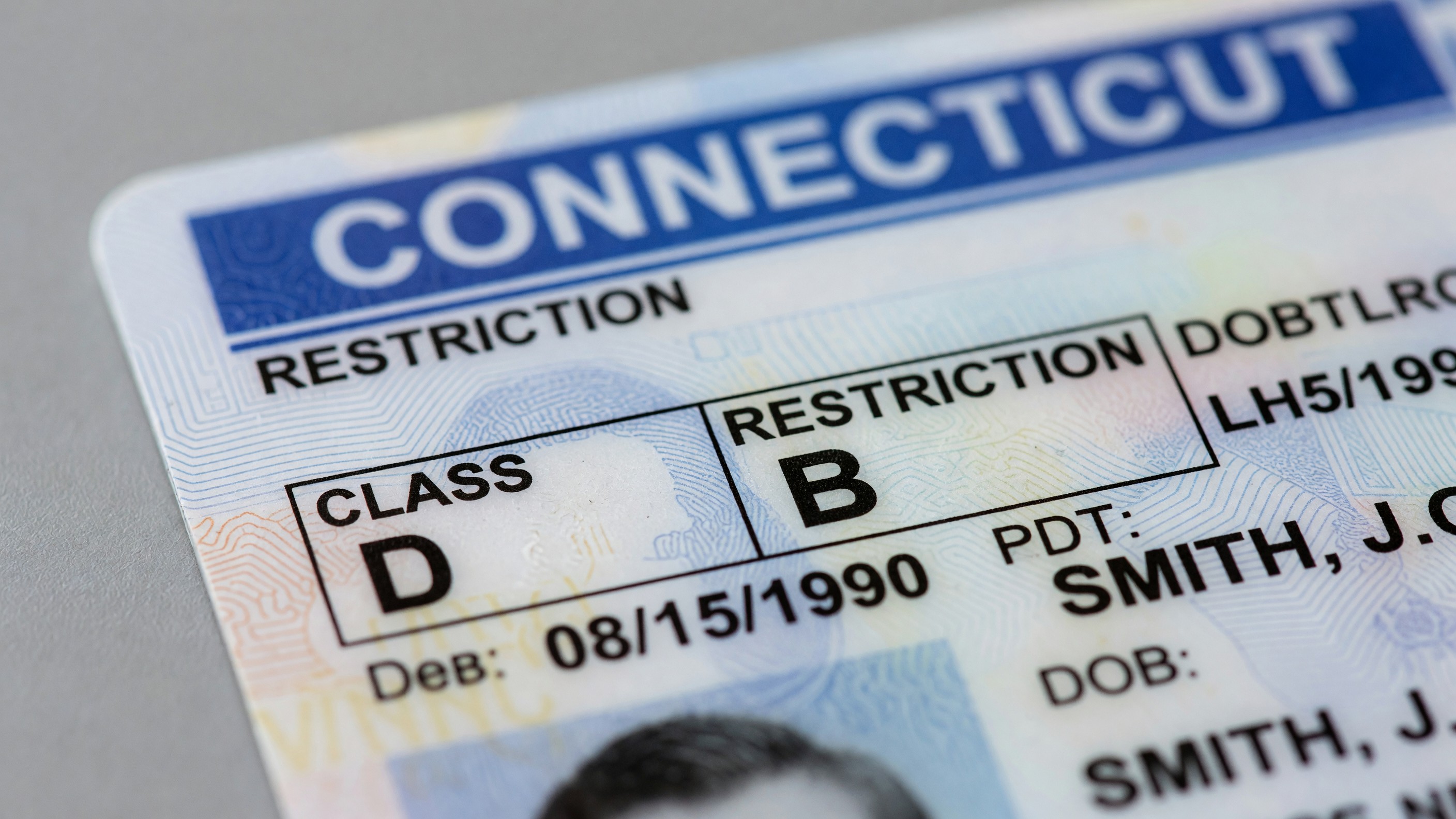
A Connecticut driver’s license carries several coded fields that most drivers never look at closely: a class letter, possibly one or more restriction codes, and for commercial license holders, endorsement codes. These codes define exactly what you are authorized to drive and under what conditions. For standard passenger vehicle drivers, the codes are simple. For commercial drivers, understanding them matters for compliance — operating a vehicle outside your authorized class or in violation of a restriction is a serious violation.
This is a reference guide to what each code means on a Connecticut driver’s license.
Class codes
The class code appears in the “Class” field. It is a single letter.
D — Standard passenger vehicle Class D is the standard Connecticut driver’s license for personal vehicle operation. Authorizes any single vehicle or combination with a combined GVWR of 26,000 lbs. or less where the towed unit is 10,000 lbs. GVWR or less, recreational vehicles, and motorcycles if the M endorsement is added. The vast majority of Connecticut license holders carry Class D.
A — Commercial: Combination vehicles A CDL authorizing any combination of vehicles where the combined GVWR exceeds 26,000 lbs. and the towed unit exceeds 10,000 lbs. GVWR. Class A holders may also operate Class B, C, and D vehicles. Covers tractor-trailers, large tanker combinations, multi-trailer rigs.
B — Commercial: Heavy straight vehicles A CDL authorizing any single vehicle with GVWR exceeding 26,000 lbs., plus any towed vehicle with GVWR of 10,000 lbs. or less. Class B holders may also operate Class C and D vehicles. Covers dump trucks, transit buses, school buses, large straight trucks.
C — Commercial: Small vehicles requiring special authorization A CDL for vehicles that don’t meet Class A or B weight thresholds but carry 16 or more passengers (including driver) or transport placarded hazardous materials. Class C holders may also operate Class D vehicles.
For a full breakdown of CDL requirements and the process for upgrading license classes, see our article on Connecticut driver’s license classes.
Restriction codes
Restrictions appear in the “Restrictions” field. Each letter represents a specific operating condition the driver must comply with at all times. Multiple restrictions may appear together.
A — Corrective lenses required The driver must wear glasses or contact lenses while operating a motor vehicle. Applied when vision testing at license issuance shows the driver does not meet the uncorrected vision standard. The most common restriction on Connecticut licenses.
B — No expressway driving Restricted from operating on limited-access highways (interstates and expressways). Applied when the driver demonstrates difficulty with high-speed highway conditions during the road test.
C — Daytime driving only License valid only during daylight hours. Applied when night vision or other factors limit safe nighttime operation.
E — Automatic transmission only The driver passed the road test in an automatic transmission vehicle and is not authorized to operate manual transmission vehicles. To have this restriction removed, a road test in a manual transmission vehicle is required.
F — Outside mirror required The driver requires an outside mirror in addition to the standard rearview mirror. Applied for drivers with limited head or neck mobility.
J — Other (see DMV record) A catchall code for a specific restriction documented in the DMV file that does not fit a standard code. The driver’s DMV record specifies the condition.
K — CDL intrastate only Commercial license valid only for intrastate (within Connecticut) operations. Applies to CDL holders who meet Connecticut’s intrastate medical standards but not FMCSA interstate standards.
L — No air brake equipped CMV The commercial driver did not demonstrate proficiency with air brake systems during the CDL skills test. May not operate commercial vehicles equipped with air brakes.
M — CDL: no Class A passenger vehicle The CDL holder’s passenger endorsement (P) is restricted to Class B and C vehicles only.
N — CDL: no Class A and B passenger vehicle The CDL holder’s passenger endorsement is restricted to Class C vehicles only.
O — No tractor-trailer The CDL holder passed the Class A skills test in a vehicle other than a tractor-trailer (e.g., a straight truck with a full trailer). Not authorized to operate a tractor with a semi-trailer.
V — Medical variance required The driver holds an FMCSA medical variance (exemption or waiver). Must carry documentation of the variance while operating a commercial vehicle.
Z — No full air brake equipped CMV Similar to restriction L but specific to full air brake systems.
Endorsement codes (CDL holders)
Endorsements authorize an additional category of vehicle or cargo beyond the base class.
| Code | Endorsement | Notes |
|---|---|---|
| H | Hazardous materials | Requires TSA background check and fingerprinting |
| N | Tank vehicles | Knowledge test required |
| P | Passenger vehicles (16+ occupants) | Knowledge and skills test required |
| S | School bus | Knowledge test, skills test, and CT-specific background check + training |
| T | Double/triple trailers | Knowledge test required |
| X | Combination tank + HAZMAT | Both H and N tests plus TSA process |
The motorcycle endorsement (M) applies to Class D licenses and authorizes operation of motorcycles and motor-driven cycles.
How to read your license
On a standard Connecticut license, the class, restriction, and endorsement fields are labeled. Examples:
- Typical passenger car driver with glasses: Class D, Restrictions: A, Endorsements: (blank)
- School bus driver, air brake qualified: Class B, Restrictions: (blank), Endorsements: P S
- CDL driver, automatic transmission only, intrastate: Class B, Restrictions: E K, Endorsements: (blank)
If your license shows restriction or endorsement codes you don’t recognize, your full DMV record is available at portal.ct.gov/DMV and will show the associated conditions in plain language.
Removing a restriction
Most restrictions require demonstrating the underlying condition no longer applies:
- A (corrective lenses): Pass a DMV vision test without lenses
- E (automatic transmission): Pass a road test in a manual transmission vehicle
- L (no air brakes): Pass the CDL air brake knowledge test and a skills test in an air brake-equipped vehicle
- B (no expressways): Retest with the examiner demonstrating expressway competency
- C (daytime only): Medical review and re-evaluation of the underlying condition
Frequently asked questions
Does a restriction show up in employer background checks? Yes. Employer-requested MVR (motor vehicle record) checks show all restrictions and endorsements. Commercial employers routinely review MVRs as part of driver qualification.
I moved from another state — will Connecticut honor my restrictions? Connecticut generally carries forward restrictions from out-of-state licenses during the transfer process. An automatic transmission restriction from another state will typically be applied to the Connecticut license. Medical restrictions may require re-evaluation.
What is the difference between liccls.htm and the license classes article? This page is a code reference — what each letter printed on your license means. For the full procedural guide to obtaining, upgrading, and testing for each license class, see Connecticut Driver’s License Classes, Endorsements, and Requirements.