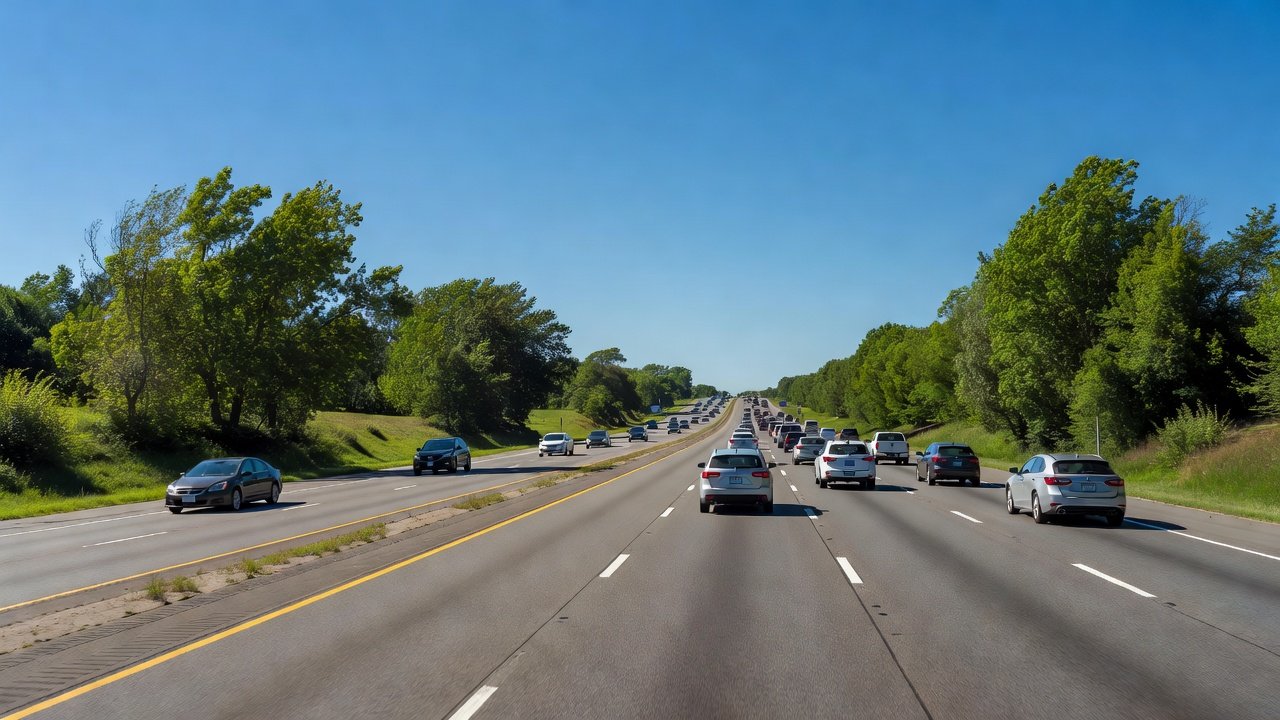
On October 1, 2026, Connecticut’s rule that the left lane is for passing becomes something police can write a ticket for. The Connecticut Department of Transportation puts the fine at $88, and the state has been running a “Pass Left. Drive Right.” awareness campaign ahead of the start date. Drivers who park themselves in the far-left lane of a multi-lane highway at the speed limit, with no one to pass, are the ones the law is aimed at.
DMVCT Compliance Review is not the Connecticut Department of Motor Vehicles or any other state agency. This guide summarizes publicly available state information and is not legal advice.
What the law changes
The change comes from Public Act 25-65, which the legislature passed in 2025 and which carries an effective date of October 1, 2026. Connecticut already had a general rule that drivers on a roadway with more than one lane should use the right-hand lane when available, with passing as the main reason to leave it. The new act sharpens that into a clearer left lane restriction on multi-lane limited access highways, which is the category that covers roads such as Interstate 95, Interstate 84, and the Merritt and Wilbur Cross Parkways.
The Connecticut Department of Transportation describes the rule plainly: the left lane is for passing. The Highway Safety Office, which sits within the state DOT, publishes a page on left lane restrictions that tells drivers to keep right except when passing, preparing for a left-hand exit, or avoiding an obstruction.
Reported coverage of the act notes that the law does not set a fixed distance or time limit for how long a driver may stay left. Enforcement is left to the judgment of the officer on the road. That matters, because it means a driver cannot assume a short stretch in the left lane is safe, and cannot assume a long one is automatically a violation if traffic conditions justified it.
The fine
The state DOT lists the penalty at $88. Some news outlets have reported higher figures in the range of the low $140s, which may reflect added costs or fees that attach to infractions, but the DOT’s own figure is the one to rely on as the base fine. If you receive a ticket, the amount printed on it and the court’s instructions control what you owe, so read the citation rather than trusting a number from an article, including this one.
Because this is a moving violation, it is also worth checking how the state handles points and records for infractions of this kind. Our guide to how Connecticut’s point system works explains how convictions are assessed and what the suspension thresholds look like. Whether this specific violation carries points is something to confirm against the statute or the DMV before assuming either way.
The exceptions
The DOT lists the situations where a driver may be in the left lane:
- Actively passing another vehicle. The key word is actively. Pulling left, pulling alongside, and moving back right when it is safe counts. Staying left for miles after a pass does not.
- Preparing for a left-hand exit. Connecticut has a number of left exits, and drivers may move over in advance of them.
- Avoiding an obstruction. A disabled vehicle, debris, or road work that makes the right lane unusable is a valid reason.
- Moving over for emergency vehicles. The DOT notes that Connecticut’s Move Over law allows temporary use of the left lane when emergency vehicles are stopped on or near the roadway.
News coverage of the act also describes carve-outs for traffic congestion and maintenance work, and says the rule does not apply to two-lane highways. If you rely on one of those, check the current statute text on the Connecticut General Assembly site, because summaries differ in how they word the details.
Driving in the left lane at the speed limit
A common misunderstanding is that traveling at the posted limit protects you. The DOT’s own guidance tells drivers to maintain the posted speed limit if they are in the left lane, but that advice sits beside the instruction to move right when you are not passing. Doing the speed limit in the left lane with open space in the right lane is the exact pattern the law targets. The speed limit is not a defense for staying left.
The same logic cuts the other way. Nothing in the law lets a driver speed to clear the left lane or tailgate the car ahead. Drivers who feel blocked still have to follow speed limits and following-distance rules. The remedy for a left lane camper is the police, not aggression.
What drivers can do now
A few habits will keep you out of trouble once enforcement begins:
- Check your mirrors before settling in. If a vehicle has come up behind you in the left lane and the right lane is open, move over.
- Plan exits ahead. If your exit is on the left, move into the left lane a reasonable distance before it, not miles earlier.
- Treat the left lane as temporary. Pass, then return. Cruise control set in the left lane is the habit to break.
- Use the right lane for steady travel. On multi-lane highways, the middle and right lanes are meant for ordinary through traffic.
- Know how to respond to a ticket. If you are ticketed and believe an exception applied, the citation tells you how to respond, and the facts you will want are the lane you were in, what was ahead of you, and what the traffic looked like.
Out-of-state and commercial drivers
The law applies to anyone driving on Connecticut’s multi-lane limited access highways, not just residents. Drivers coming from states with similar rules, including neighboring New York and Massachusetts, may already be used to the habit. Drivers from states without a left lane rule are the ones most likely to be caught off guard. Professional drivers face the same fine, with the added consequence that a moving violation can affect their record and their employer’s insurance picture, so fleet managers may want to brief drivers before October 1.
Why the state is doing this
State officials have framed the rule as a safety measure. The DOT quotes its commissioner as saying that camping in the left lane when you are not passing creates frustration and unsafe conditions for everyone on the road. The reasoning is straightforward: when slower traffic sits in the passing lane, faster drivers weave around it on the right, and the mix of lane changes raises the odds of a collision. The point of the law is to restore a predictable pattern, passing on the left, traveling on the right.
Before October 1
The practical takeaway is simple. If you drive Connecticut highways regularly, spend the next few weeks noticing how often you sit in the left lane without passing, and fix the habit before there is a fine attached to it. Read the Highway Safety Office page and the text of Public Act 25-65 on the General Assembly site so you know the wording of the exceptions, and keep a record of the DOT’s $88 figure only as a starting point. The law is simple to follow when you keep right unless you have a reason to be left.