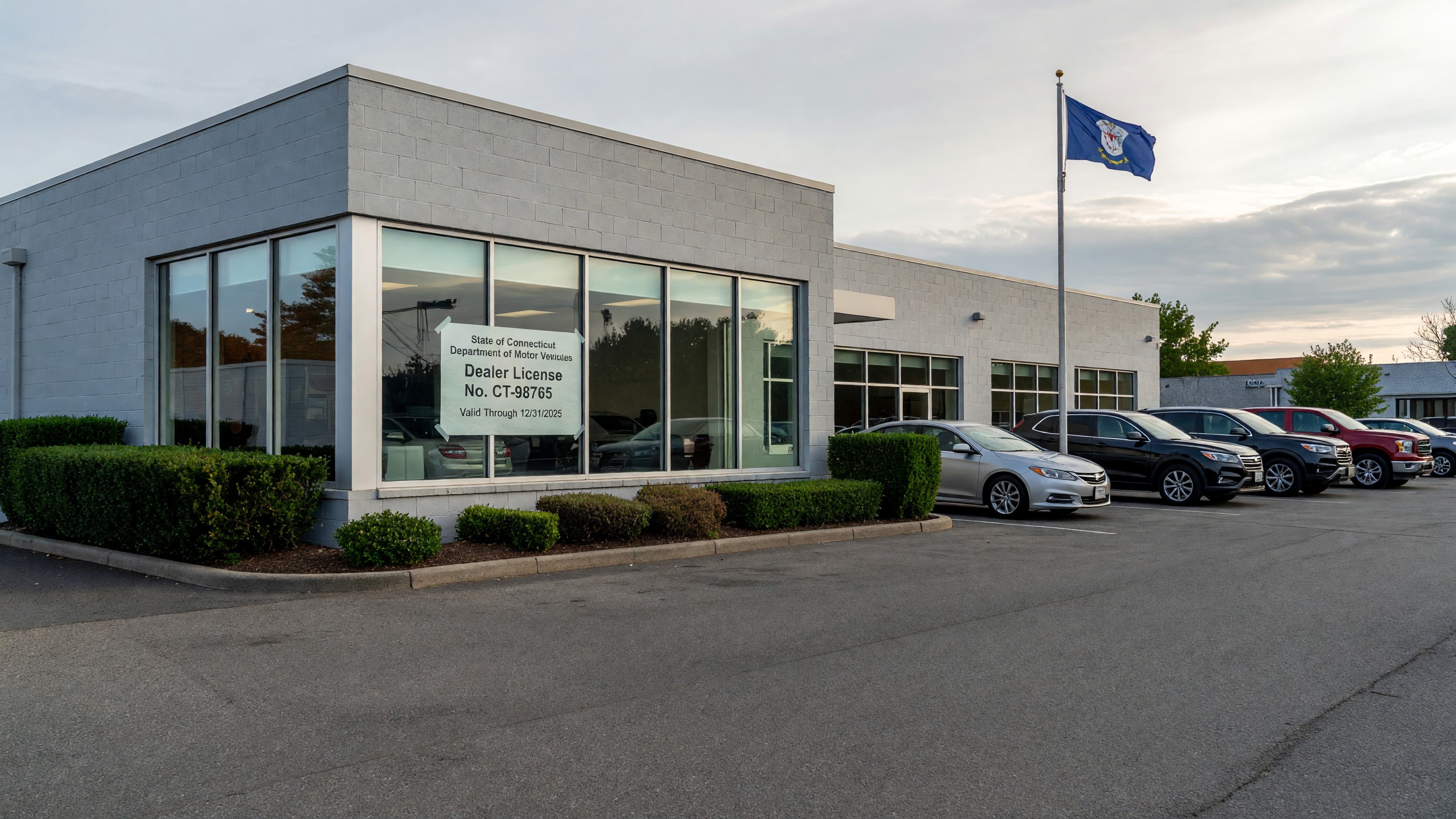
The Connecticut Department of Motor Vehicles licenses every business that sells motor vehicles, repairs them, or stores them for any of the regulated purposes — and that license is the hard line between a legal operation and a serious civil and criminal exposure. There are thousands of licensed dealers and repairers in the state, and there is a multi-decade pattern of unlicensed operations being shut down, often with criminal charges against the principal.
This guide walks through the Connecticut auto dealer and repairer licensing program in 2026: who needs which license, how to apply, the surety bond and zoning approval requirements, the renewal cycle, and what triggers DMV suspension or revocation of an existing license.
Primary-source references in this article point to forms and rules at portal.ct.gov/DMV/Dealers-and-Repairers. Connecticut’s dealer-and-repairer rules are codified at Connecticut General Statutes §§ 14-51 through 14-67, with administrative regulations in Title 14 of the Regulations of Connecticut State Agencies.
Which businesses need a Connecticut license
Connecticut’s dealer-and-repairer law sweeps broadly. Any business that meets one of the following descriptions needs a license from the Connecticut DMV before operating:
- New car dealer. Sells new motor vehicles under a manufacturer franchise.
- Used car dealer. Sells used motor vehicles, including a single-vehicle retail operation. Note: Connecticut’s hobbyist exemption permits a private individual to sell a small number of personally-owned vehicles per year, but the moment the business pattern looks dealer-like — inventory held for resale, repeated purchases, advertising — the DMV considers it a dealer operation.
- Repairer. Performs repairs, maintenance, or body work on motor vehicles for compensation. This includes specialty shops (transmission, glass, tires, audio) and mobile repair operations.
- Limited repairer. Performs a narrower scope of repair work (typically a single specialty) and qualifies for a reduced license category with a smaller bond.
- Wrecker. Operates a tow truck and engages in the recovery, transportation, or storage of motor vehicles. Wrecker licensing intersects with rate regulation under Connecticut’s tow-rate schedule.
- Recycler. Buys vehicles for parts or scrap and dismantles them. Recyclers must also comply with environmental rules under the Department of Energy and Environmental Protection.
The categories are not mutually exclusive — a business that both sells used cars and repairs them needs both a dealer license and a repairer license.
The license application process
Connecticut uses Form K-7, the Application for Licensure as a Motor Vehicle Dealer, Repairer, or Other Service, plus a series of supporting documents. The full application package is typically 20 to 30 pages including attachments and runs 60 to 120 days from submission to issuance in normal DMV processing conditions.
Business formation and location
Before submitting Form K-7, the business must exist as a legal entity registered with the Connecticut Secretary of the State (LLC, corporation, sole proprietorship, or partnership) and must have a specific physical location. Connecticut does not license dealers or repairers without a fixed location — there is no “mobile dealer” category, and a P.O. box does not satisfy the location requirement.
The location must meet zoning requirements for the licensed activity. This is the single most common reason a license application is delayed: the applicant signs a lease for a property zoned for retail or commercial use but not specifically zoned for motor vehicle sales or repair, and the local zoning board’s approval becomes a months-long parallel process to the DMV application.
Zoning approval
Connecticut requires the applicant to obtain written approval from the local zoning enforcement official certifying that the proposed location is zoned for the activity being licensed. This certification is part of the Form K-7 package. Some municipalities have specific local rules layered on top — a maximum number of vehicles displayed, lot lighting requirements, fence and screening standards.
The zoning step can be the rate-limiting one for a new dealer. Connecticut has municipalities where every motor-vehicle-sales-zoned parcel is already occupied, and the applicant must either find a parcel currently used for a similar purpose (taking over an existing site) or seek a variance, which is uncertain and slow.
Surety bond and certificate of insurance
Connecticut requires a surety bond from every licensed dealer and repairer. Current bond amounts:
| License type | Bond amount |
|---|---|
| New car dealer | $50,000 |
| Used car dealer | $25,000 |
| Repairer | $5,000 |
| Limited repairer | $1,000 |
| Wrecker | $25,000 |
| Recycler | $25,000 |
The bond is held by a Connecticut-admitted surety company and is payable to the State of Connecticut for the benefit of any person who suffers loss due to fraud, misrepresentation, or unfair business practices by the licensee. The bond does not protect the licensee — it protects the licensee’s customers.
A general liability insurance certificate (typical minimum $300,000 combined single limit) is required in addition to the surety bond. Workers’ compensation coverage is required for any licensee with employees.
Background check
Connecticut runs a state and federal criminal background check on every principal of the applying business — owners, officers, and directors. Certain criminal history triggers either an automatic denial or a heightened review. Recent felony convictions involving fraud, theft, or motor vehicle title offenses are the most common disqualifiers.
The DMV does not publish a categorical list of disqualifying convictions. The agency considers each case in context — the nature of the offense, time elapsed, evidence of rehabilitation, and the specific license being sought.
DMV facility inspection
Before issuing a license, a DMV inspector visits the proposed location to verify it meets the operational requirements: a fixed office, telephone, posted business hours, secure record storage, adequate display or repair space, lighting, signage, and a sign that meets the Connecticut DMV’s minimum dimensional and content rules.
The inspector also verifies that the business is not yet operating. Operating before licensure is grounds for denial and, in some cases, criminal referral.
License issuance and posting
Once Form K-7 is approved, the surety bond and insurance are on file, the background check is clean, and the inspection passes, the DMV issues the license. The license must be posted conspicuously at the licensed location at all times.
The license is not transferable. If the business changes ownership, the new owner must apply for a new license. If the business relocates, a new application is required for the new location.
Renewal and continuing obligations
Connecticut dealer and repairer licenses run for a two-year term. The DMV mails a renewal notice approximately 60 days before expiration. Renewal requires:
- Current surety bond and insurance certificate on file
- Continued compliance with zoning and operational requirements
- Renewal fee — which varies by license type, currently in the $200 to $500 range for most categories
- Affirmation of no material changes (ownership, location, business name)
Material changes between renewals require notice to the DMV within 30 days. Selling the business, adding a new partner, or relocating without notice is grounds for license suspension.
Beyond the renewal cycle, licensees are subject to ongoing compliance audits and consumer-complaint review. The DMV operates a dealer-complaint resolution process that licensees must participate in: a customer who alleges fraud, misrepresentation, or unfair business practice can file a complaint with the DMV, which investigates and can mediate or refer the matter to the Office of Attorney General.
Suspension, revocation, and the path back
The DMV has authority to suspend or revoke a license for cause. The most common triggers:
- Title-related fraud. Selling a vehicle with a salvage or rebuilt title disclosed as clean. Failing to record an existing lien.
- Odometer tampering or misrepresentation. Connecticut and federal law (49 U.S.C. § 32705) require accurate odometer disclosures on every sale.
- Unfair or deceptive trade practices. Bait-and-switch advertising, misrepresentation of warranty terms, deceptive financing disclosures.
- Failure to maintain required records. Connecticut requires dealers and repairers to maintain records of every transaction for seven years.
- Operating outside the licensed location. Conducting sales or repairs at a different address than the licensed one.
- Lapse of surety bond or insurance. A licensee whose bond or insurance lapses must cease operating immediately; continued operation during the lapse is grounds for revocation.
A suspended licensee can request a hearing under the Uniform Administrative Procedure Act before the suspension becomes final. The hearing examines the evidence, allows witnesses, and produces a written decision that can be appealed to the Connecticut Superior Court.
Reinstatement after a revocation is rare but possible. The reinstated business is treated as a new applicant — full Form K-7, full background check, full inspection — and must show rehabilitation factors that address the original revocation grounds.
Frequently asked questions
Do I need a Connecticut dealer license to sell a few used cars per year?
The state’s hobbyist exemption allows a private individual to sell a small number of personally-owned vehicles in a year without licensure. The DMV looks at the totality of the business pattern: vehicles purchased specifically for resale, advertising, repeated sales, a place of business, or holding inventory all suggest dealer activity. Selling a single personal vehicle is fine; running a side business in used cars without a license is grounds for shutdown.
How much does a Connecticut auto dealer license cost?
The DMV fee for an initial used car dealer license is in the $400 to $700 range; new car dealers are in the $700 to $1,200 range. Beyond the DMV fee, the applicant pays for the surety bond (typically $250 to $1,500 in annual premium for a $25,000 to $50,000 bond depending on credit), zoning review fees, and any local business license fees. Total all-in startup is commonly $2,000 to $5,000 before the first vehicle is sold.
How long does the application process take?
In normal conditions, 60 to 120 days from a complete submission. The two most common delays are zoning approval (which is a separate municipal process) and the surety bond underwriting for applicants with thin credit history.
Can I run a repair shop without a Connecticut repairer license?
No. Performing repair, maintenance, or body work on motor vehicles for compensation requires a Connecticut repairer license regardless of operation size. A single-person mobile repair operation needs the same license as a multi-bay shop. The limited repairer category is a reduced version for narrower scope (typically single-specialty operations) and carries a smaller bond.
What happens if my license lapses?
A lapsed license requires a new application. Continuing to operate after a lapse is grounds for criminal referral under Connecticut General Statutes § 14-67. If the lapse is administrative (the renewal was filed late but the business has been compliant), the DMV may allow re-licensure on a faster track. If the lapse is substantive (the surety bond was canceled, the insurance dropped), the business must cure those issues before re-applying.
Is the dealer license tied to the location or the business?
Both. The license names the business entity and the specific location. Moving to a new location requires a new application. Selling the business requires the new owner to apply. A license cannot be transferred to a different entity or location even within the same town.
For the current Form K-7 and the dealer-and-repairer fee schedule, see the Connecticut DMV Dealers and Repairers portal. For other licensing topics under Connecticut motor vehicle law, see our Compliance section.