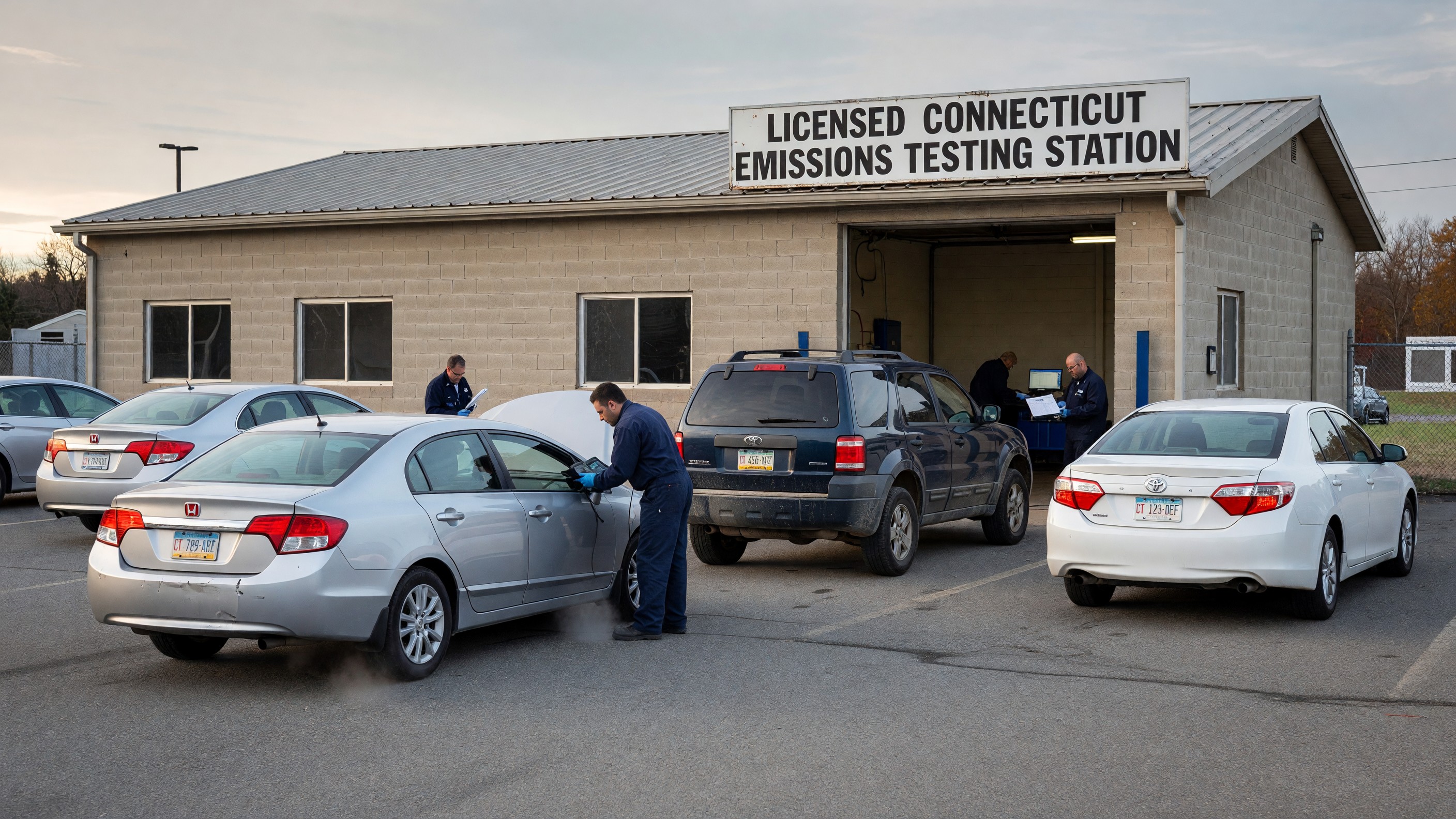
Connecticut requires most gasoline-powered vehicles to pass an emissions inspection before each registration renewal. The program is one of the longer-running in New England — designed to reduce air pollutants that contribute to the state’s ozone and particulate non-attainment status under the federal Clean Air Act. For most drivers, the test is a routine part of the two-year registration cycle. For drivers with aging or mechanically troubled vehicles, it can be the trigger for a costly repair decision.
This article covers how the Connecticut emissions testing program works in 2026: which vehicles must test, how the inspection is performed, where to go, what happens after a failure, and the limited waiver options for vehicles with repair costs that exceed the state’s cost-effectiveness threshold.
Which vehicles must have an emissions test in Connecticut
Connecticut’s emissions testing mandate covers all gasoline-powered motor vehicles model year 1968 and newer, with the following exemptions:
- New vehicles: Vehicles in their first two model years (a 2025 model year vehicle is exempt through the 2026 model year)
- Antique vehicles: Vehicles 25 years old or older registered under the antique vehicle classification per Connecticut General Statutes § 14-1
- Diesel-powered vehicles: Diesel engines are exempt from the gasoline-program OBD-II and tailpipe testing requirements
- Electric and hydrogen fuel cell vehicles: Zero-emission vehicles produce no exhaust and are exempt
- Heavy vehicles: Gasoline vehicles with a gross vehicle weight rating (GVWR) above 8,500 pounds are exempt from the light-duty program
- Off-road only registrations: Vehicles registered exclusively for off-road use
All other gasoline-powered vehicles in the model year 1968-and-newer range, registered in Connecticut, must test every two years.
When testing is required
Connecticut aligns emissions testing with registration renewal. The test is due every two years, timed to the vehicle’s registration renewal month. You do not receive a separate testing notice — the renewal notice from DMV indicates whether an emissions test is required for that renewal cycle.
Testing can be performed up to 90 days before the registration expiration date. Results are electronically transmitted to the DMV by the testing station; there is no paper certificate to submit. If a vehicle fails and is repaired, it can be retested at any licensed station.
How the inspection works
Connecticut runs two types of emissions tests depending on the vehicle’s model year:
OBD-II inspection (model year 1996 and newer)
Vehicles 1996 and newer are equipped with the standardized OBD-II diagnostic system, which continuously monitors the vehicle’s emissions control components. The inspection involves connecting a diagnostic scanner to the OBD-II port and reading two categories of data:
Fault codes (DTCs). If the vehicle’s computer has stored a diagnostic trouble code for an emissions-relevant system — the catalytic converter, oxygen sensors, evaporative emissions system, exhaust gas recirculation system, or others — the vehicle fails the test.
Readiness monitors. OBD-II vehicles run internal self-tests on their emissions systems. If too many monitors show “not ready” — typically because the battery has been recently disconnected or the vehicle hasn’t been driven through a complete warm-up cycle since the reset — the vehicle fails for incomplete monitors.
The most common cause of a readiness-monitor failure is a recent battery replacement or disconnection. The fix is straightforward: drive the vehicle for several days through varied conditions (cold starts, highway speeds, complete warm-up cycles) and retest.
Tailpipe test (model year 1968–1995)
Older vehicles without OBD-II systems receive a physical exhaust test. The vehicle is run on a dynamometer at set speeds while emissions analyzers measure hydrocarbons (HC), carbon monoxide (CO), and in some test configurations nitrogen oxides (NOx). Pass/fail cutoffs are model-year specific.
Finding a licensed testing station
Connecticut does not operate state-run test lanes. Testing is performed at licensed private stations — service stations, dealerships, and dedicated inspection facilities that have applied for and hold a DMV testing license.
The Connecticut DMV maintains a searchable database of licensed emissions testing stations at portal.ct.gov/DMV/Emissions. Testing fees are regulated by the state.
For historical context, this site’s archive covered per-town emissions station listings for Connecticut cities including Thomaston, Windsor, Groton, Middletown, Waterbury, Willimantic, Manchester, Stratford, and New Haven. The current official station database at portal.ct.gov/DMV is the authoritative directory — individual station locations, hours, and operating status change frequently.
What happens after a failure
A failing vehicle receives a test record from the station showing which component or monitor triggered the failure. The vehicle can be repaired and retested at any licensed station.
If the vehicle fails for a fault code: The underlying fault must be diagnosed and repaired. Simply clearing the code without addressing the cause will result in the same code reappearing and a repeat failure.
If the vehicle fails for incomplete readiness monitors: No repair is needed — drive the vehicle normally for several days and retest.
Retest: Connecticut allows one free retest within 30 days of a paid initial inspection at the same station. Retests at different stations may incur the standard test fee.
Repair cost waiver
If a vehicle fails and the cost of repairs needed to bring it into compliance exceeds the state’s established cost-effectiveness limit, the owner may apply for a waiver that allows registration renewal despite the continuing failure.
To qualify:
- The vehicle must have already failed inspection
- The owner must have spent at least the minimum threshold amount on qualifying repairs
- Repairs must have been performed at a licensed facility
- Receipts documenting repair costs must be submitted to DMV
A waiver is a one-cycle accommodation, not a permanent exemption. Current waiver thresholds and the application process are described at portal.ct.gov/DMV/Emissions.
Common failure causes
Catalytic converter degradation. The most expensive common failure. A failing converter typically triggers a P0420 or P0430 code.
Oxygen sensor failure. O2 sensor faults are frequent and relatively inexpensive to fix.
EVAP system leaks. Evaporative emissions codes are often caused by a loose gas cap, cracked hose, or faulty purge solenoid. A loose cap is the first thing to check before spending money on diagnostics.
EGR system issues. More common on higher-mileage vehicles.
Frequently asked questions
Can I sell a vehicle that failed the emissions test? Yes. Connecticut law does not prohibit the private sale of a vehicle with an open emissions failure.
What if my check engine light is on but for a non-emissions reason? Connecticut’s testing program flags codes associated with emissions control systems specifically. A code for an unrelated sensor would not trigger an emissions test failure.
Do I need to bring anything to the testing station? Your vehicle and valid registration. Payment for the test fee.
My vehicle is from out of state — do I need to test? Any vehicle newly registered in Connecticut enters the standard testing cycle. Connecticut requires its own inspection regardless of test records from other states.