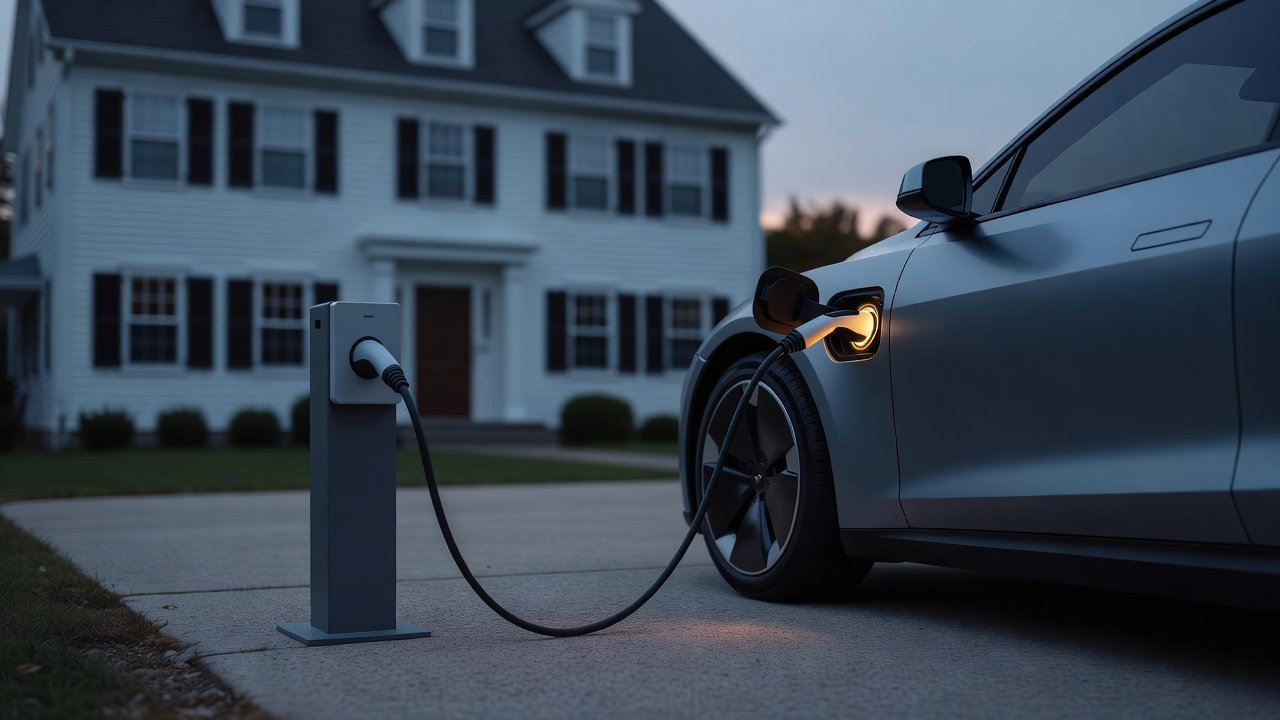
Connecticut lawmakers floated a bill this year that would have nearly tripled what it costs to register an electric vehicle. It never made it out of committee, but the funding problem it was written to solve hasn’t gone away, and drivers who assume the idea is dead should understand why it surfaced in the first place.
What HB 5568 actually proposed
House Bill 5568, “An Act Increasing the Motor Vehicle Registration Fees for Electric Vehicles,” would have raised Connecticut’s triennial EV registration fee from $120 to $345 — nearly a threefold increase. Plug-in hybrids would have jumped from the same $120 base to $233, roughly double. Both figures apply to the state’s standard three-year registration cycle, not an annual fee, so the comparison to what EV owners currently pay is direct: the same three-year window, a much larger number at the end of it.
The bill’s stated purpose was shoring up the Special Transportation Fund, the account that finances Connecticut’s road and bridge work along with DOT and DMV operations. The fund draws heavily on the state’s fuel tax, and that revenue source erodes every time a gas-powered car is traded for one that doesn’t buy gasoline at all. Legislators backing the increase argued EV owners should contribute something comparable to what gas-tax-paying drivers already put in, since EVs use the same roads without touching the tax that maintains them.
Why it stalled
The bill was referred to the Finance, Revenue and Bonding Committee and got a single public hearing on March 27, 2026. The testimony that followed ran overwhelmingly against it. Written opposition came in from the CT League of Conservation Voters, Clean Transportation Communities of Southern CT, and a string of individual EV owners, several of whom made the same core argument: the Special Transportation Fund was not, at the time of the hearing, actually running a deficit. One opponent’s testimony cited the fund as currently in surplus, with a shortfall not projected until roughly 2030 — undercutting the bill’s framing as an urgent fix rather than a preemptive one.
Opponents also leaned on a fairness argument grounded in scale. EVs and plug-in hybrids together make up roughly 3% of Connecticut’s light-duty vehicle fleet. Even a full fee increase across that entire population, opponents argued, would raise a relatively small amount of revenue against the fund’s overall needs, while landing disproportionately hard on the drivers who happened to be early adopters of a technology the state has actively subsidized and encouraged for years through its own rebate programs. The hearing record shows at least one voice in support — testimony favoring the increase did exist — but it was a clear minority against a wide field of opposition, and the bill never advanced out of committee for a floor vote.
What this means for EV owners right now
Nothing changes today. Connecticut’s registration fee for every passenger vehicle, electric or otherwise, remains $120 per three-year cycle, and there is currently no EV- or PHEV-specific surcharge layered on top of it. If you’re registering or renewing an EV in Connecticut this year, you’re paying the same base fee as a gas-powered sedan owner down the street.
That said, treating this bill’s failure as a permanent resolution would be a mistake. The underlying fiscal pressure on the Special Transportation Fund is structural, not a one-year anomaly — fuel efficiency has been climbing for two decades, the state’s gas tax isn’t indexed to inflation, and every EV added to Connecticut’s roads is one more vehicle that doesn’t contribute to that tax base under the current system. None of that reverses on its own. It’s the kind of gap that legislatures tend to revisit once the fund’s finances look tighter than they did at this year’s hearing, and the Office of Fiscal Analysis projections cited in testimony put a real deficit on the horizon later this decade.
What to watch
Two things are worth tracking if you own or are considering an EV in Connecticut. First, the Special Transportation Fund’s annual condition — its surplus-versus-deficit trajectory is the single number that will determine whether a fee-increase bill gets a friendlier reception next session than HB 5568 got this year. Second, watch for alternative mechanisms that raise the same revenue without singling out EVs by name, such as a broader mileage-based user fee or a flat surcharge applied across all vehicle types regardless of fuel source — approaches that sidestep the “why penalize the cars we’re trying to promote” objection that sank this particular bill.
There’s also a policy-consistency argument that came up repeatedly in the hearing record and is worth understanding even if you never testify on a bill yourself. Connecticut runs its own EV purchase incentive program, CHEAPR, which pays buyers a rebate for choosing an electric or plug-in hybrid vehicle in the first place. Opponents of HB 5568 pointed out the awkwardness of a state actively subsidizing EV purchases on one hand while nearly tripling the ongoing cost of owning one on the other — two programs pulling in opposite directions on the same population of drivers. That tension doesn’t disappear just because this particular bill stalled, and it’s likely to shape how any future fee proposal gets framed, whether as a standalone EV surcharge or folded into a broader road-funding mechanism that doesn’t single out one fuel type.
The bigger picture for buyers deciding now
None of this should be the deciding factor in whether to buy an EV in Connecticut today — the fee, even at the proposed $345 tripled rate, works out to roughly $115 a year, a small fraction of what most drivers spend on fuel savings alone over a comparable period. But it’s a useful data point for anyone budgeting a multi-year total cost of ownership: treat the current $120 fee as a number that could plausibly move upward before your next renewal cycle, not as a fixed constant, and build a small margin into any long-range comparison against a gas-powered alternative.
If a similar proposal returns, the Finance, Revenue and Bonding Committee’s public hearing process is the point where it can still be shaped or stopped, and written testimony from individual drivers demonstrably factored into this year’s outcome. Registering to receive committee hearing notices through the General Assembly’s website is a low-effort way to know before a bill reaches a vote rather than after.