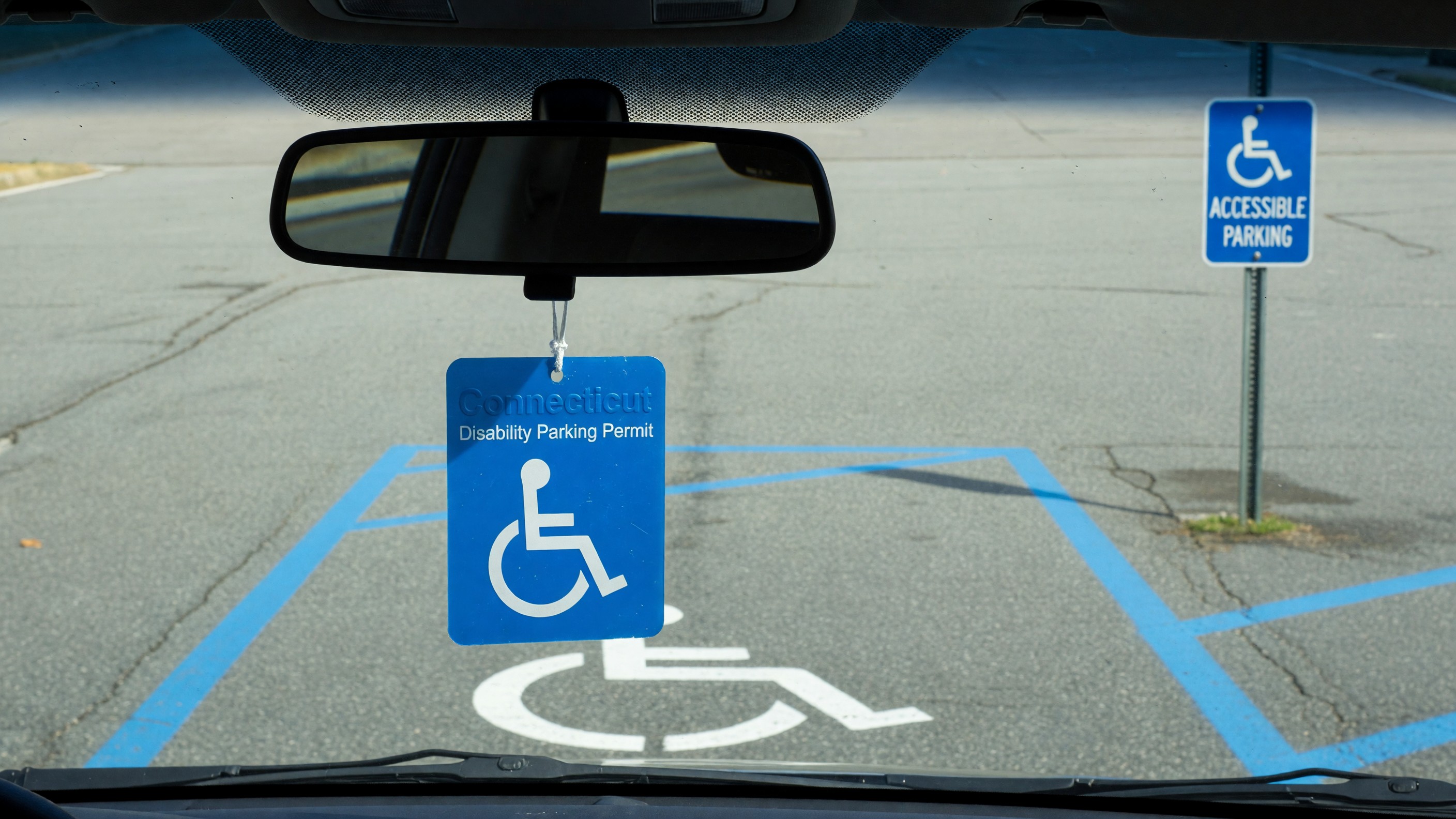
For roughly half a million Connecticut residents living with a qualifying mobility impairment, the state’s disability parking program is one of the most consequential compliance touchpoints with the DMV. The placard is small, the application is short, and yet the process trips up applicants every year — usually on the medical-certification step, the temporary-to-permanent transition, or the misunderstanding that the placard is tied to the person and not the vehicle.
This guide walks through how the Connecticut Department of Motor Vehicles administers disability parking permits in 2026: who qualifies, how to file Form B-225, the differences between temporary and permanent placards and disability plates, what renewal looks like, and how the permit travels across state lines.
The references in this article point to primary sources at portal.ct.gov/DMV. Connecticut updates its forms and fee schedules periodically — the current PDF on the DMV portal is always the authoritative version.
Who qualifies for a Connecticut disability parking permit
Connecticut law sets six categories of qualifying impairment for a disability parking permit. A licensed medical practitioner must certify that the applicant meets at least one:
Cannot walk 200 feet without stopping to rest. This is the most common category and the one most physicians use for older applicants with mobility limitations from age, arthritis, or chronic conditions.
Cannot walk without the assistance of another person or an assistive device — a cane, brace, crutch, prosthetic, walker, or wheelchair.
Restricted by lung disease to the extent that forced expiratory volume in one second (FEV1) is less than one liter, or arterial oxygen tension is less than 60 mm Hg on room air at rest.
Severely limited by a cardiovascular condition classified as Class III or Class IV under the American Heart Association’s New York Heart Association functional classification.
Severely limited by a neurological, orthopedic, or arthritic condition.
Uses portable oxygen or is legally blind under state law.
The qualifying condition determines whether the applicant is eligible for a temporary placard or a permanent placard or plate. A broken leg in a cast that will heal in three months qualifies for a temporary placard. End-stage chronic obstructive pulmonary disease qualifies for a permanent placard.
A common misunderstanding: the applicant doesn’t need a single diagnosis to be eligible. They need to meet one of the functional criteria above. A physician certifying “cannot walk 200 feet without rest” is making a clinical observation about function, not diagnosing a specific disease.
What kinds of permits Connecticut issues
Connecticut issues three distinct credentials under the disability parking program. Applicants pick one — or in some cases combine — based on need.
Temporary placard
A red placard valid for the duration the certifying medical practitioner specifies, up to six months. If the condition has not resolved by that point, the placard can be renewed once for an additional six months, for a total maximum of twelve months. After that, the applicant either no longer needs a placard or moves to a permanent placard via a new application.
The temporary placard is the right choice for post-surgical recovery, fractures expected to heal, cardiac events with rehabilitation timelines, and pregnancy-related mobility limitations.
Permanent placard
A blue placard valid for two years from the date of issuance. The DMV mails a renewal notice approximately 60 days before expiration. The renewal application requires a new medical certification — the state does not assume that a permanent placard automatically continues without re-verification.
This is the right choice for chronic conditions where the functional limitation is expected to persist. The two-year renewal is administrative, not a re-evaluation of whether the underlying condition warrants the permit.
Disability license plates
Instead of (or in addition to) a placard, an eligible applicant can obtain a disability license plate that replaces the standard plate on a registered vehicle. The plate makes the disability accommodation tied to a specific vehicle rather than transferable between vehicles.
Most applicants prefer the placard because it transfers — they can hang it in any vehicle they are riding in, including a friend’s, a taxi, or a rental. The license plate is more useful when the registered vehicle is the one the applicant always travels in.
A vehicle owner can hold disability plates and also carry a placard. The two credentials are independent.
How to apply: Form B-225 step by step
The Connecticut DMV uses Form B-225, the Application for Special License Plate or Removable Windshield Placard for Persons with Disabilities. The form is a single double-sided page with three parts.
Part 1 — Applicant section
The applicant completes their name, mailing address, date of birth, Connecticut driver’s license or non-driver ID number, and contact phone. The applicant must sign and date this section.
The form asks the applicant to indicate which credential is being requested: temporary placard, permanent placard, or disability license plate (or a combination). Most applicants check only one.
Part 2 — Medical certification
A licensed Connecticut physician, advanced practice registered nurse (APRN), physician assistant (PA), podiatrist, or chiropractor completes Part 2. The practitioner certifies which of the six qualifying categories applies, indicates whether the condition is temporary or permanent, and (for temporary) lists the expected duration.
The certifying practitioner signs, dates, prints their name and license number, and provides the office address.
Three procedural notes that trip applicants up:
- Out-of-state physicians can certify. Connecticut accepts medical certification from any physician licensed in the United States, not just Connecticut-licensed. Snowbird applicants who see their primary care provider in Florida can have that physician complete Part 2.
- The certification is the rate-limiting step. Most rejected applications fail because Part 2 is incomplete — missing license number, missing duration field on a temporary, missing signature, or a certifying provider not in the allowed credential list (registered nurses and licensed clinical social workers, for example, are not eligible to certify).
- Medical certification expires. If the applicant doesn’t submit the form within 90 days of the medical signature, the DMV will reject the form and require fresh certification.
Part 3 — Submission
Connecticut accepts Form B-225 by mail to the Department of Motor Vehicles, Special Plates Unit, in Wethersfield, or in person at any DMV office. The current mailing address and office locations are listed on the form itself.
There is no fee for the placard itself. Disability license plates carry the standard plate fee for the vehicle being plated. The placard processing time is typically two to three weeks by mail; in-person submission at a DMV office can sometimes issue the placard same-day, though staffing variation makes this unreliable.
How long the permit is valid, and how to renew
Renewal cycles depend on the credential type:
| Credential | Initial term | Renewable? |
|---|---|---|
| Temporary placard | Up to 6 months | Yes, one renewal of up to 6 months (12 months total maximum) |
| Permanent placard | 2 years | Yes, every 2 years, requires fresh medical certification |
| Disability license plate | Standard plate cycle (2 or 3 years depending on type) | Yes, with vehicle registration renewal |
Connecticut mails a renewal notice for the permanent placard roughly two months before expiration. The notice includes a partly pre-filled Form B-225 — the applicant fills in current contact information, has the medical practitioner re-certify, and returns it.
A common failure mode: the applicant assumes the permanent placard renews automatically and discovers at a parking enforcement stop that the placard has been expired for months. Connecticut considers an expired placard the same as no placard for enforcement purposes, and the fine is identical to using no placard at all.
The DMV will also reissue a lost or stolen placard. The replacement process requires a sworn statement that the original is no longer in the applicant’s possession; the replacement is free for permanent placards within the existing term.
Using a Connecticut placard out of state
Federal law — specifically 23 CFR § 1235 — directs every state’s transportation agency to accept disability parking credentials issued by any other state. A valid Connecticut placard is honored in California, Massachusetts, Florida, and every other state. Foreign-issued disability placards (Canada, the United Kingdom, the European Union) are also generally honored, though enforcement varies by jurisdiction.
Three practical points to keep in mind when traveling:
- Carry the placard, not a photocopy. Enforcement officers in most jurisdictions will treat a photocopied placard as no placard. The actual hangtag must be in the vehicle.
- Carry identification matching the placard. The placard is tied to the named individual, not the vehicle. An officer can ask the person displaying the placard to show identification matching the name. If the placard holder isn’t present and the placard is being used by a family member, that’s a misuse violation in most states — even where the placard was issued in another state.
- Local rules can layer on top. New York City, for example, has additional placard rules above and beyond what New York State issues. Reciprocity covers the basic right to use accessible parking; it doesn’t override local time limits or zone restrictions unless those are statutorily linked to the placard.
For applicants who relocate to Connecticut from another state with an active disability placard, Connecticut requires a new application via Form B-225 once the person establishes residency. The out-of-state placard is honored for visitors but not for residents — the same rule that applies to driver licenses applies to disability placards.
Misuse, enforcement, and revocation
Connecticut takes placard misuse seriously, and the enforcement landscape has tightened over the last decade. The most common misuse cases:
- A family member uses the placard when the placard holder is not in the vehicle.
- A placard holder lends the placard to someone else.
- A placard continues to be displayed after the holder has died.
- A placard is altered or counterfeit.
Penalties range from a fine in the $150 to $500 range for first-offense misuse up to revocation of the placard, suspension of the holder’s driver’s license, and (for counterfeit cases) criminal charges. Some municipalities have dedicated parking enforcement units that pursue placard misuse aggressively in commercial districts where accessible spaces are in high demand.
A placard holder whose underlying medical condition has resolved is obligated to return the placard to the DMV. There is no legal mechanism to “let it expire” in lieu of returning it when the qualifying condition is gone. In practice, the DMV does not pursue voluntary returns aggressively — but the obligation exists, and using a placard after the condition resolves is misuse.
Frequently asked questions
How do I get a disability parking permit in Connecticut?
File Form B-225 with the Connecticut DMV. Part 1 is the applicant’s information; Part 2 must be completed by a licensed physician, APRN, PA, podiatrist, or chiropractor certifying that the applicant meets one of six qualifying conditions. Submit by mail to the DMV Special Plates Unit or in person at any DMV office. The placard itself is free.
How long does a temporary disability placard last in Connecticut?
A temporary placard is valid for the duration the certifying practitioner specifies, up to six months. It can be renewed once for an additional six months, for a total maximum of twelve months. After that, the applicant must either no longer need a placard or apply for a permanent placard.
Can my doctor sign my CT disability placard application?
Yes — if the doctor is a physician (MD or DO), APRN, physician assistant, podiatrist, or chiropractor licensed in any U.S. state, not just Connecticut. Registered nurses, social workers, and physical therapists cannot certify the form. The certification must be signed within 90 days of submission to the DMV.
Do I need to renew my Connecticut disability placard?
Permanent placards are renewed every two years, with fresh medical certification each cycle. The DMV mails a renewal notice about 60 days before expiration. Temporary placards expire on the date specified by the certifying practitioner and require a new application if a renewal is needed.
Can I use my Connecticut disability placard in another state?
Yes. Federal regulation 23 CFR § 1235 requires every state to honor disability placards issued by every other state. Carry the actual hangtag (not a photocopy) and identification matching the placard. Local time limits or zone restrictions may still apply.
Is there a fee for a Connecticut disability parking permit?
The placard itself is free. Disability license plates carry the standard Connecticut plate fee for the vehicle being plated. Replacement of a lost or stolen permanent placard is free during the existing term.
What happens if a placard is used by someone other than the named holder?
That’s misuse under Connecticut law. The placard is tied to the person named on it, not to a vehicle or a family member. A family member driving the placard holder around can display it when the holder is in the car; using it when the holder is not present is a violation, generally fined $150 to $500 for a first offense and grounds for revocation on repeat offenses.
For the current Form B-225 and the authoritative fee schedule, see the Connecticut DMV special plates page. For broader compliance topics across the state’s motor vehicle program, see our Compliance section.